Three price bands for an adult trike, and what your money actually buys at each one
What separates a discount department-store trike from a mid-range aluminum build and a specialist recumbent, which parts fail first, and which upgrades a rider feels inside a week.
Solid axle versus differential
Inexpensive trikes drive only one rear wheel through a solid shaft, which makes the machine pull sideways under power and scuff its tires in tight turns. A differential rear axle drives both wheels and is one of the clearest markers of the middle price band.
Assembly cost nobody quotes
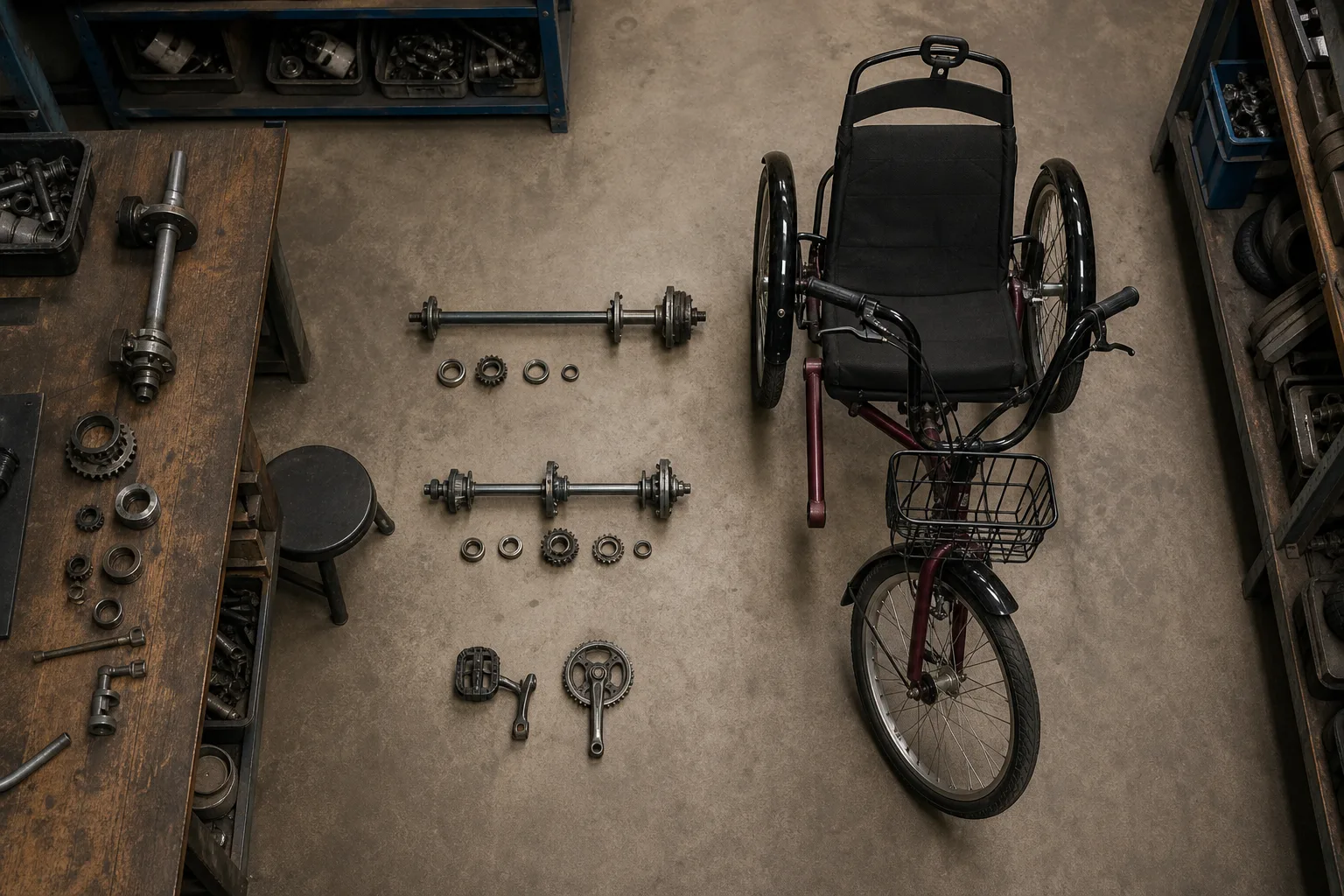
Boxed trikes typically arrive with the fork, handlebar, pedals, basket and rear axle uninstalled. Shop labor to finish and correct that work is a real expense, and some shops decline unfamiliar frames outright.
First components to fail
Unsealed rear wheel bearings usually go first, followed by steel rims losing true, then a stretched chain and worn freewheel. Cables and plastic shifter bodies corrode or crack shortly after.
Haw River Valley A trike stands upright on its own, so it rolls away on any slope unless something holds it. A locking parking brake is standard on mid-range machines and often missing or ineffective at the discount end.
Adult three-wheelers sort themselves into three rough bands, and the gaps between them are wider than the price tags suggest. At the bottom sits the steel single-speed or seven-speed sold in a box, assembled by whoever unpacks it. In the middle sits an aluminum-framed machine with a real drivetrain, real brakes and a shop that will adjust it. At the top sits the specialist recumbent, built in small numbers by companies that make nothing else. Each band solves a different problem, and the money buys different things: not simply better parts, but a different set of ongoing costs.
What the discount trike includes, and what it leaves out
A department-store or online-only trike arrives with a steel frame, steel rims, a coaster or basic caliper brake, a single-wall wheel build, and a rear axle driving one wheel through a solid shaft. That last detail matters more than the price. Without a differential, one wheel pushes and the other trails, which is why these machines pull to one side under power and scuff in tight turns. The bearings are usually loose ball, unsealed, packed lightly at the factory. Nothing here is unusable. It is simply built to a number, and the number governs every choice.
The cost that does not appear on the receipt is assembly and correction. Boxed trikes typically ship half-built, with the fork, handlebar, pedals, basket and rear axle left to the buyer. A shop will charge for finishing that work, and many shops decline it entirely because liability on an unfamiliar frame is not worth the labor rate. The Consumer Product Safety Commission is responsible for the federal requirements that apply to bicycles sold in the United States, including how they are shipped and what instructions come with them, so the paperwork in the box is worth reading before anything gets torqued.
Which parts wear out first at the cheap end
The failure order is predictable enough to plan around. Wheel bearings go first, particularly the rear pair, because they are unsealed and carry the weight of a rider sitting behind the bottom bracket. Then the rims: steel rims stop poorly in the wet and go out of true under a heavier rider, and once a single-wall rim is bent, truing it is a temporary measure. Then the chain and freewheel, which stretch quickly under low-cadence pedaling. Cables and housing corrode at the entry points, and the plastic shifter body cracks where the cable enters.
None of this arrives on a schedule you can budget for, which is the practical objection. A rider who uses the machine three or four times a week for errands should expect the first meaningful repair within a season of regular use, and the repair frequently costs a visible fraction of the purchase price. That arithmetic pushes many buyers toward the middle band on the second purchase rather than the first, which is a normal path and not a mistake, only an expensive way to learn what the middle band offers.
The mid-range aluminum build, and the differential question
Move up a band and several things change at once. The frame becomes aluminum, so it does not rust where the paint chips at the rear fender stays. The wheels become double-wall alloy with sealed or better-adjusted bearings. The brakes become linear-pull or mechanical disc, with a parking brake that actually holds on a driveway slope. Most importantly, many mid-range machines include a differential rear axle, so both wheels drive and the trike tracks straight instead of crabbing. Assembly is usually partial rather than total, and the seller has a dealer network behind it.
This is also the band where electric assist becomes common and worth having, because a hub motor mounted in a steel single-speed overwhelms the rest of the machine. Shopping an electric tricycle in the middle band means the brakes, wheels and frame were specified with the extra weight and speed already in mind. Battery capacity, controller quality and the presence of a torque sensor rather than a cadence sensor are the differences a rider feels on a hill, and they are the ones worth asking a dealer to state in writing.
The specialist recumbent, and what the premium pays for
A tadpole recumbent, two wheels forward and one behind, is a different vehicle rather than a better version of the same one. The rider sits low in a mesh seat, weight distributed across a long wheelbase, which raises cornering limits substantially and removes the tipping feel that upright trikes have on a crowned road. Drivetrains run to wide-range derailleur or internal-hub setups with genuinely low crawler gears. Frames fold or break down for transport. Component quality is a step up throughout, and small-batch manufacturers tend to support parts for many years.
The premium buys three things concretely: stability at speed, comfort over distance, and a service life measured in decades rather than seasons. It costs a great deal more, and it costs garage space, since even folding models are long. For a rider covering real mileage or managing back or wrist pain, the money resolves a problem that no upgrade to an upright trike will resolve.
The upgrades a rider notices within a week
If the machine is already bought, a small number of changes pay back fast. A proper saddle and a fitted seatpost, sized to the rider rather than the box, change everything about a thirty-minute ride. Replacing the tires with a puncture-resistant pair at a sensible pressure changes rolling feel and roadside luck at once. Cable and housing replacement makes shifting and braking crisp again for very little money. Grips, mirrors and a real parking brake follow. These are the upgrades felt immediately, and they cost far less than a rebuild.
The honest way to compare bands is to add the first two years of likely repairs to the sticker price and then look again. Done that way, the discount trike and the mid-range aluminum build often land closer together than the shelf suggests, and the recumbent starts looking less like an indulgence and more like a long amortization. Match the band to the miles you actually intend to ride.
Where assist belongs
A hub motor added to a steel single-speed outpaces the brakes and wheels around it. Electric assist is best specified from the frame up, with braking and wheel build chosen for the extra weight and speed.Torque versus cadence sensing
A cadence sensor turns the motor on when the pedals move; a torque sensor responds to how hard the rider pushes. The difference is most noticeable starting on a grade from a standstill.Tadpole geometry
Two wheels forward and one behind, with the rider seated low across a long wheelbase, raises cornering limits and removes most of the tipping sensation upright trikes have on crowned roads.New to trikes? How road crown, speed and track width decide whether you stay down
A trike will not lean into a corner, so the road's crown, your speed and the machine's track width do the work instead. Here is how to test that before you buy.
Your trike has to fit through a door and into a car. What to measure first
Track width against real door openings, what a folding hinge costs in stiffness, solo lifting weight, and the rack options that work on a frame with no top tube.
Can't stand on the pedals? How low gearing and a small motor compare on a long climb
For a trike rider who has to climb seated, a wide-range cassette, an internal hub, and a modest hub motor each solve the grade differently, and each costs something elsewhere.